VR Simulation
Master the ECG routine before the patient is real.
MetaMedicsVR's ECG simulation lets students run the full electrocardiogram routine on a virtual patient — reading the clinical case, placing every electrode, printing the strip, answering guided interpretation questions — with a score and corrections at the end of every attempt.
Through the lens
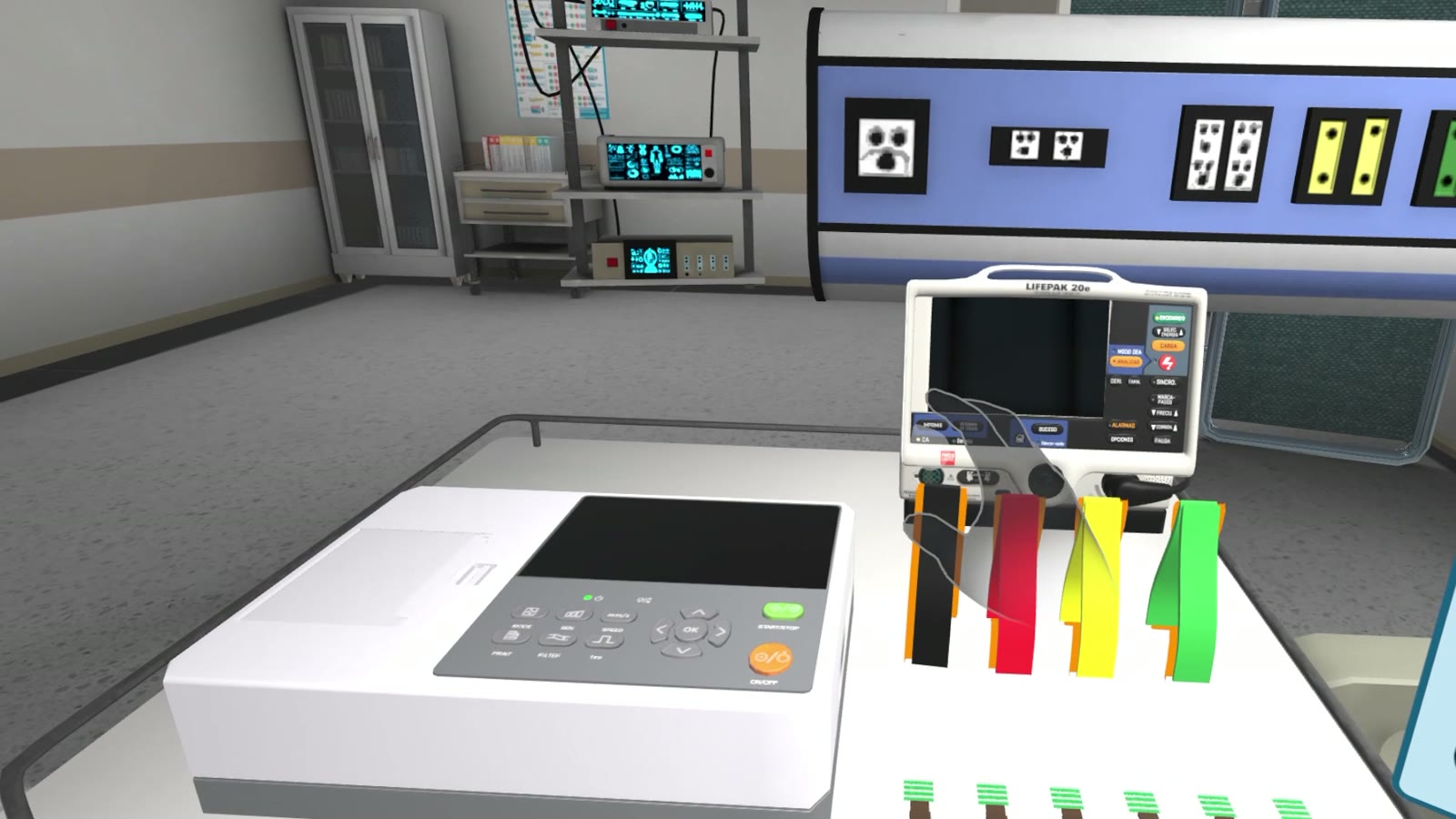
The ECG station, exactly as students will see it.
Patient, ECG cart, and monitor — the full working environment of an electrocardiogram, captured directly from the simulator.
- Virtual patient
- Electrodes & leads
- Monitor & trace
What makes it different
-
Correct placement, every time
Limb electrodes first, then the six numbered precordials on the torso — placed on a virtual patient and repeated until the sequence is automatic, with no gel, no wires, and no volunteer required.
-
Interpretation is part of the routine
The machine prints the strip and the simulator asks the questions a tutor would — identify the rhythm, estimate the rate. Reading the ECG is trained, not assumed.
-
No patient, no waiting
Practising the ECG routine usually needs a volunteer and an ECG cart. In VR, every student gets their own station and unlimited repetitions.
-
A clinical case behind every test
Each practice starts from a case — presenting complaint and clinical history included — so the ECG is read in context, the way it will be on a real shift.
How a session runs
Every session follows the same loop — case, electrodes, strip, score.
- 01
Choose
Open the case
The student starts at their own ECG station and opens a clinical case — presenting complaint, clinical history, and the patient ready on the couch.
- 02
Place
Position the electrodes
Limb electrodes first, then the six precordials — numbered on the torso, so a misplaced electrode is visible at a glance.
- 03
Interpret
Read the strip
The machine prints the strip and the simulator asks guided questions: identify the rhythm, estimate the rate, decide what needs attention.
- 04
Review
Get the score
Every attempt ends with a mark and its corrections — what went well, what to repeat — and the next try is seconds away, not another appointment.
What it covers
Electrode & lead placement
The core manual skill of the ECG: limb electrodes and precordials V1–V6, positioned correctly on the patient until the sequence needs no thinking.
A strip printed like the real one
The simulator prints the trace the way the machine in a consultation room does — and students learn to tell a clean strip from one that needs redoing.
Basic rhythm recognition
Guided questions over the printed strip — identify the rhythm, estimate the rate — connect what the trace shows with what it means.
Who it's for
- Nursing degrees and schools
- Medical schools and health sciences faculties
- Vocational healthcare programs
- Hospital and clinical training units
- Continuing education for clinical staff
From the blog
Keep exploring this topic.
 Simulation & VR
 Why repetition is the missing piece in clinical training
On a real placement, a student might face a critical scenario once. In simulation, they can rehearse the same case again and again. That difference is what turns knowledge into skill.
 Health education
 Learning by doing in healthcare: from methodology to measurable outcomes
"Learning by doing" sounds right, but accreditors ask for outcomes, not slogans. This is how to tie the methodology to evidence you can actually defend.
 Practical training
 From theory to practice: closing the gap in vocational health training
Vocational health programs are judged on one thing: can graduates do the job on day one? Here is why the gap between the classroom and the hospital floor opens, and how repeatable, hands-on practice in virtual reality helps close it.
GET STARTED
See the ECG simulation in a demo.
Tell us how your program teaches the ECG today — we'll show you where the simulator fits, in a 20-minute session with your team.
Thanks — we’ve got your request.
We’ll be in touch within one business day.